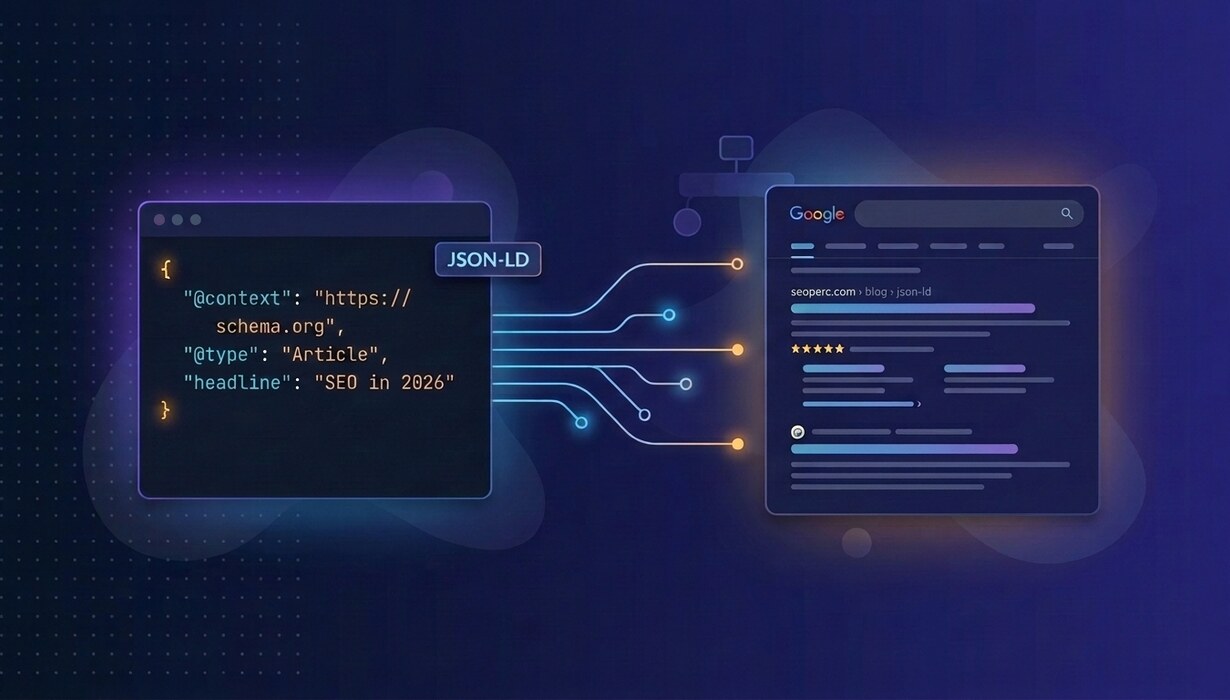
As of July 2026, JSON-LD runs on 54.6% of all websites (W3Techs, Usage Statistics of JSON-LD for Websites). At the same time, Google has spent three straight years deleting the rich results that markup used to earn — FAQ rich results disappeared from Search entirely on May 7, 2026. So the honest question isn't "what is JSON-LD?" anymore. It's "is this still worth my time?"
The answer is yes — but for narrower, more deliberate reasons than most schema guides admit. In this article we'll look at what the markup actually buys you in 2026, what Google has quietly taken away, what the newest AI-citation data shows, and which schema types still earn their maintenance cost.
The Short Answer: Yes — but Not for the Reason Most Guides Give You
In 2026, you still need JSON-LD because it remains the only reliable way to qualify for the roughly 30 rich result types Google still supports (Google Search Central, Structured Data Gallery) — not because it ranks you higher, and not because it wins AI citations. Both of those popular claims fail against current evidence.
Think of it this way: schema markup is a presentation layer, not a promotion layer. It decides whether your listing shows stars, prices, breadcrumbs, and thumbnails. Those extras change click behavior — and clicks, not markup, are what pay your bills. Everything below follows from that distinction.
What Is JSON-LD, and Why Did It Win the Format War?
JSON-LD (JavaScript Object Notation for Linked Data) is Google's recommended structured data format, and by 2026 it dominates the alternatives: 54.6% of websites use JSON-LD against 21.9% for Microdata (W3Techs, Structured Data Formats Overview, July 2026). Google's own documentation states it "recommends using JSON-LD for structured data if your site's setup allows it."
Why did it win? Unlike Microdata, which forces attributes into every HTML tag, JSON-LD lives in one self-contained script block. You can generate it from a template, swap it without touching your layout, and validate it in isolation. Here's a minimal example:
<script type="application/ld+json">
{
  "@context": "https://schema.org",
  "@type": "BlogPosting",
  "headline": "Do I Really Need JSON-LD for SEO in 2026?",
  "datePublished": "2026-07-22",
  "author": { "@type": "Organization", "name": "SeoPerc" }
}
</script>JSON-LD is now the leading schema.org syntax — Microdata has fallen to under half its adoption. Source: W3Techs, July 2026.
Adoption isn't proof of value, of course — 54.6% of the web also once had a Flash intro. But it does mean tooling, CMS plugins, and validators are built JSON-LD-first, which lowers your implementation cost to nearly zero. That matters when we weigh cost against payoff later.
Is JSON-LD a Google Ranking Factor?
No — and Google has been unusually consistent about this. In February 2025, John Mueller reaffirmed that structured data "won't make a site rank better" (Search Engine Journal), echoing his position held since 2018. Google's documentation says markup makes pages eligible for rich results; it never promises them (Google Search Central, Intro to Structured Data).
Mueller's own analogy is the clearest one in circulation: schema markup is like giving Google directions to the party — it doesn't get you invited. The ranking systems decide relevance and quality from your content; structured data just labels what's already there.
So why do so many case studies show traffic jumps after adding schema? Because the jump comes from click-through rate on richer listings, not position changes. Same rank, better-dressed result, more clicks. That's a real effect worth pursuing — it's just a different mechanism than "schema boosts rankings," and confusing the two leads teams to expect gains on pages that were never rich-result candidates in the first place.
What Do Rich Results Actually Pay in 2026?
The largest public dataset on this remains Milestone Research's click-curve study: across 4.5 million queries and 2.7 billion impressions collected in 2019–2020, rich results earned 58 clicks per 100 queries versus 41 for non-rich results (Milestone Research, SEO Click Curves, published 2021). That's a 41% relative lift from presentation alone.
Rich results out-earned plain listings by 17 clicks per 100 queries — and the best performer of all was later removed by Google. Source: Milestone Research.
Google's own published case studies point the same direction, though they date from the 2017–2019 era: Rotten Tomatoes measured 25% higher CTR on pages with structured data, Nestlé found rich-result pages earned 82% higher CTR than non-rich pages, and Food Network saw a 35% increase in visits after marking up 80% of its pages (Google Search Central, retrieved July 2026).
Notice the uncomfortable detail in that chart, though. The single best-performing rich result in the Milestone study — FAQ, at 87 clicks per 100 queries — is the one Google killed. Renting visibility features from Google means Google can repossess them. That's not an argument against schema; it's an argument against building your CTR strategy on any single rich result type.
Google Keeps Deleting Rich Results — Should You Care?
Between August 2023 and May 2026, Google retired more than a dozen rich result types, from FAQ and HowTo to sitelinks search box and an entire batch of seven types in June 2025 (Google Search Central changelog, retrieved 2026-07-22). If your schema strategy dates from 2022, part of it is now decorating a feature that no longer exists.
| When | What Google removed |
| Aug–Sep 2023 | FAQ rich results restricted to authoritative government and health sites; HowTo rich results deprecated |
| Oct–Nov 2024 | Sitelinks search box retired globally |
| Jun 2025 | Seven types deprecated at once: Course Info, Claim Review, Estimated Salary, Learning Video, Special Announcement, Vehicle Listing, Book Actions (the last reinstated in Nov 2025) |
| Sep 2025 | Search Console reporting removed for the deprecated types |
| Nov 2025 – Jan 2026 | Practice problems markup phased out, plus nutrition facts, nearby offers, and event features |
| May 7, 2026 | FAQ rich results removed from Google Search entirely |
Does that mean schema is dying? Google says no — pointedly. In November 2025, responding to exactly that narrative, John Mueller said "markup types come and go, but a precious few you should hold on to" (Search Engine Journal, Google Is Not Diminishing the Use of Structured Data in 2026). The removals targeted lesser-used types that, in Google's words, were "no longer providing significant additional value."
The practical read: Google is consolidating, not abandoning. Your job is to stop spreading markup across every type that ever existed and concentrate on the survivors — which we'll list in a moment.
Does JSON-LD Get You Cited by AI Search?
In May 2026, Ahrefs ran the first controlled experiment on this — and the answer stings. Tracking 1,885 pages that added JSON-LD against 4,000 control pages, they found AI Overview citations moved −4.6%, AI Mode +2.4%, and ChatGPT +2.2% — the latter two statistically indistinguishable from zero (Ahrefs, We Tracked 1,885 Pages Adding Schema. AI Citations Barely Moved.).
That matches Google's official line. Its AI-features documentation states plainly: "There's also no special schema.org structured data that you need to add" to appear in AI Overviews or AI Mode (Google Search Central, AI Features and Your Website, retrieved July 2026). The models read your rendered content, not your annotations.
Microsoft, on the other hand, gives schema more credit. At SMX Munich in March 2025, Bing's Principal Product Manager Fabrice Canel said schema markup "helps Microsoft's LLMs understand your content" (Search Engine Land, Microsoft Bing/Copilot Use Schema for Its LLMs). So the honest 2026 summary is: schema is a comprehension aid for some AI systems, not a citation lever for any of them.
Meanwhile, the AI shift is reshaping what those clicks are worth. Pew Research Center found that in March 2025, when an AI summary appeared, users clicked a traditional result in just 8% of visits versus 15% without one — and clicked a source inside the summary only 1% of the time (Pew Research Center, July 2025). Ahrefs measured a 34.5% drop in position-one CTR when an AI Overview is present (Ahrefs, AI Overviews Reduce Clicks, 2025).
When an AI summary appears, clicks on traditional results nearly halve — schema markup can't fix that, which is why CTR-focused rich results matter more, not less. Source: Pew Research Center, 2025.
Here's the connection most coverage misses: as AI summaries shrink the pool of available clicks, the clicks that remain get more competitive. A listing with stars, prices, and breadcrumbs competes better for a scarcer resource. So the AI era doesn't make JSON-LD obsolete — it quietly raises the stakes on the rich results that survived.
Which Schema Types Are Still Worth Adding in 2026?
Google's structured data gallery lists roughly 30 supported rich result types as of July 2026 (Google Search Central), but for most sites, fewer than ten of them do the real work. Prioritize by what your pages actually are — not by what a plugin can generate.
| Schema type | Use it on | What you get in 2026 |
| Product (+ Review, Offer) | E-commerce pages | Stars, price, and stock in listings — the highest-impact survivor |
| Article / BlogPosting | Editorial content | Headline and image treatment, clear authorship and dates |
| Organization | Home / about pages | Entity clarity: logo, name, profiles — feeds knowledge panels |
| BreadcrumbList | Everything | Readable URL paths in results; trivial to implement |
| LocalBusiness | Location pages | Hours, address, and reviews tied to your entity |
| Recipe / VideoObject / Event / JobPosting | Niche verticals | Still-active carousels and enriched listings where relevant |
And the ones to stop maintaining for Google? FAQ and HowTo markup no longer produce anything in Google Search, and the June 2025 batch (Course Info, Claim Review, Estimated Salary, Learning Video, Special Announcement, Vehicle Listing) is gone too. Leaving old markup in place does no harm — Bing's systems still read it — but new investment there earns nothing from Google.
How Do I Implement and Validate JSON-LD Without Breaking Anything?
Google recommends JSON-LD precisely because implementation is a contained, low-risk task: one script block per page, matching your visible content (Google Search Central, retrieved July 2026). The workflow that avoids most of the problems we see has five steps:
- Pick the type that matches what's on the page. A blog post is a BlogPosting, not a Product — combine types only when the page genuinely contains both, the way an article with a real FAQ section can legitimately carry BlogPosting plus FAQPage (this page does exactly that, mostly for Bing's LLMs). (5 minutes)
- Generate the block from your template or CMS, so dates and titles update themselves instead of drifting out of sync. (30–60 minutes, once)
- Only mark up what's visible. Google's guidelines require the markup to describe content users can actually see — invented reviews and hidden text are how sites earn manual actions. (ongoing discipline)
- Validate the syntax with the free SeoPerc JSON-LD Validator — paste your code or URL and it flags malformed JSON, missing required properties, and type errors before Google ever sees them. (2 minutes)
- Confirm rich-result eligibility with Google's Rich Results Test, then re-check after every template change. (5 minutes)
Why the paranoia about validation? Because JSON-LD fails silently. A single trailing comma doesn't throw an error on your page — the parser just discards the whole script block, and your markup quietly stops existing. The failures we see most often in submissions to our own validator are exactly this kind: trailing commas, unescaped quotes inside headlines, and Review markup for reviews that don't appear anywhere on the page. None of them are visible in the browser. All of them zero out your eligibility.
| Check your markup in 30 seconds Paste any URL or JSON-LD snippet into the free SeoPerc JSON-LD Validator. It catches syntax errors, missing required properties, and schema.org type mismatches — the silent failures that cost you rich results. Validate your JSON-LD free → |
If you hand-edit markup, draft it in a live editor first — our HTML Code Editor lets you preview the script block in a full page context before you ship it.
When Can You Skip JSON-LD?
Honestly? More often than schema vendors admit. If your pages match none of the ~30 supported rich result types — internal dashboards, thin utility pages, login screens — markup earns you nothing, because eligibility for nothing is still nothing. Google's own June 2025 deprecation rationale was that the removed types were "not commonly used in Search" (Google Search Central Blog, Simplifying Search Results, June 2025).
Skip it too when the markup would describe things your page doesn't show. And if you're pinning AI-visibility hopes on it, recall the 2026 Ahrefs experiment above: adding schema didn't move citations for already-indexed pages. Content quality and crawlability do that work.
One caveat cuts the other way: Ahrefs' authors note schema may still help undiscovered pages and ambiguous entities get understood correctly. A brand-new site with zero entity footprint has more to gain from an accurate Organization block than an established one does.
Frequently Asked Questions
(And yes — this page carries FAQPage markup for the section below. Not for Google, which dropped FAQ rich results in May 2026, but because Bing's LLMs still parse it. A live demonstration of the trade-off discussed above.)
Is JSON-LD a Google ranking factor in 2026?
No. Google's documentation states structured data makes pages eligible for rich results but doesn't guarantee them, and John Mueller reaffirmed in 2025 that it won't make a site rank better. The payoff is presentation: rich results earned 58 clicks per 100 queries versus 41 for plain listings (Milestone Research).
Does JSON-LD help you get cited in AI Overviews or ChatGPT?
The best current evidence says barely. In 2026, Ahrefs tracked 1,885 pages that added JSON-LD and found AI Overview citations moved −4.6% and ChatGPT +2.2% — statistically indistinguishable from zero. Google says no special markup is needed for AI features; Microsoft says schema helps Bing's LLMs understand content.
Should I use JSON-LD, Microdata, or RDFa?
Use JSON-LD. Google explicitly recommends it, and adoption reflects that: as of July 2026, JSON-LD runs on 54.6% of all websites versus 21.9% for Microdata (W3Techs). It sits in one script block instead of being woven through your HTML, which makes it far easier to generate, update, and validate.
Should I remove FAQ and HowTo markup now that those rich results are gone?
You can leave it, but stop investing in it for Google. FAQ rich results were removed from Google Search on May 7, 2026, and HowTo was deprecated in September 2023. The markup does no harm, remains valid schema.org, and Bing's LLMs still parse it — removal is optional housekeeping, not an emergency.
How do I check if my JSON-LD is valid?
Paste your markup or URL into the free SeoPerc JSON-LD Validator to catch syntax errors, then run Google's Rich Results Test to confirm eligibility against the ~30 rich result types Google still supports in 2026. Re-validate after every template change — one stray comma silently disables the whole block.
The Verdict
Yes — in 2026 you still need JSON-LD, but as a precision tool, not a ritual. It won't move your rankings (Google has said so for seven years), and it won't buy AI citations (Ahrefs measured that in 2026). What it does is win richer listings for the page types Google still enhances.
That job matters more now, not less. With AI summaries cutting traditional clicks from 15% to 8% of visits (Pew Research Center, 2025), every presentational edge on the remaining clicks counts double.
So here's the whole strategy in three lines. Mark up what your pages actually are, using the surviving types: Product, Article, Organization, Breadcrumb, LocalBusiness, and your vertical's specials. Skip the graveyard: FAQ, HowTo, and the 2025 deprecation batch. And validate every block before it ships, because markup that doesn't parse is markup that doesn't exist.